
Captain Maurice Newsome
(Kalo or Lali Paltan?)
by John Harrop
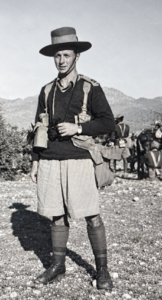
Maurice Newsome as a Lieutenant on the North-West Frontier in 1940.
Captain Maurice Newsome died in a motor accident at Murree on 4 August 1943. According to his entry in the 2nd Goorkhas Register of British officers, the Commonwealth War Graves Commission (CWGC) did not record his name and burial details, and his name does not appear on the regimental brass memorial tablet for officers of the Regiment who gave their lives in the Second World War. However, CWGC did record his details as an officer of the 7th Gurkha Rifles. How did this come about?
Maurice Cecil Vesey Newsome was born on 19 May 1919 in Bradfield, the son of Mr Cecil Arnold Vesey Newsome MC*, late Durham Light Infantry. He was educated at King’s College School, Wimbledon, where his father was a master at the Junior School. He was a fine sportsman, representing the school at athletics, cricket, rugby and tennis. In 1937 he won an entrance scholarship to the Royal Military College, Sandhurst, from where he was gazetted in July 1939 to the Unattached List Indian Army (ULIA). He was then sent to the 1st Battalion, The East Yorkshire Regiment, a year’s attachment to a British regiment being a pre-requisite for officers joining the Indian Army. His time with them was curtailed by the outbreak of the Second World War, and he joined the 2nd Battalion of the 2nd Goorkhas at Damdil, Waziristan on 3 February 1940. He is thought to have been the last regular officer to join the Regiment from Sandhurst before wartime Emergency Commissioned Officers started to arrive. Later in 1940 he was transferred to the newly raised 3rd Battalion, and in March 1941 was sent to the 4th Battalion being raised in Dehra Dun as Officer Commanding B Company.
His service in three Battalions of the Regiment makes for an impressive Sirmoor pedigree, but it was probably frustration at not being sent to North Africa with the 1st Battalion or Malaya with the 2nd which led him to volunteer, along with many others from the 2nd Goorkhas, for service in 50th Indian Parachute Brigade when it was raised by Brigadier ‘Bill’ Gough MC, his erstwhile Commanding Officer in the 2nd Battalion, in October 1941. Shortly before joining the new Brigade, Maurice Newsome married Miss Dorothy May Blossom George in Delhi, and their son Edward was born on 16 April 1943.
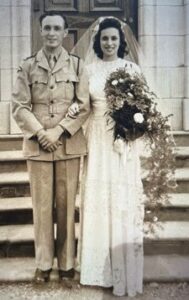
Maurice Newsome and his wife on their wedding day.
50th Indian Parachute Brigade initially consisted of three parachute battalions: 151 made up of British troops; 152 comprising Indian soldiers; and 153 consisting of Gurkhas. 153 Gurkha Parachute Battalion, in which Newsome served and where he qualified as a parachutist, was raised and commanded by another distinguished 2nd Goorkha, Lieutenant Colonel Freddie Loftus-Tottenham (later Major General CBE, DSO and bar).
In November 1942 151 Parachute Battalion was redeployed to another formation in Egypt. It was replaced by the newly-created 154 Gurkha Parachute Battalion. This mainly consisted of men from 3rd Battalion 7th Gurkha Rifles which had fought bravely during the early 1942 withdrawal from Burma across the Sittang River to India, but in the process reducing its strength to only six officers and about 300 men. Based at Amritsar, the new parachute unit was commanded by another 2nd Goorkha, Lieutenant Colonel Hugh Parsons, who was later awarded the DSO when commanding the 1st Battalion Assam Rifles. He invited Maurice Newsome, by now an experienced parachutist, to join them. In agreeing to this, Newsome effectively became attached to the 7th Gurkha Rifles (even though the battalion’s designation had been changed to 154 Gurkha Parachute Battalion). However, Newsome is not listed in 7th Gurkha Rifles records as someone who served with them, nor is he on their Roll of Honour of British officers who lost their lives on active service during the Second World War. In a further complication, Brigadier Bill Gough refers to Maurice Newsome twice as the Commander of the Indian Wing of the Parachute Landing School at Willingdon Airfield, Delhi, once in the History of the 2nd King Edward’s VII’s Own Goorkhas Volume III, and again in the January 1943 edition of Regimental News. This suggests that not long after joining 154 Gurkha Parachute Battalion Newsome was given this training role, disassociating him from any connection with the 7th Gurkha Rifles, and implying that at the time of his death he was on Extra-Regimental Employment (ERE) – as a 2nd Goorkhas officer.
Lieutenant Colonel Hugh Parsons explained the circumstances of Maurice’s death in a letter to his parents:
‘He was driving back with some other officers after having done a recce in the hills before taking his company up there for a training camp. It was a dark night, and the accident occurred at a dangerous S-bend…and he sustained a double fracture of the skull. When I saw him, he was still conscious, and I sent a car immediately for his wife, who was with him when he died.
He was buried here [Murree] with full military honours, and his own company – ‘A’ Light Company (154 Gurkha Parachute Battalion) found the escort and firing party. The bearers were the Gurkha officers of the battalion, and the pallbearers were six of his brother officers and two Flight Lieutenants from the Air Landing School.
We have suffered a great loss by his death; especially as I knew Maurice when he first joined the regiment to which I also belonged before being given command of this battalion. Consequently, when looking for officers, I at once asked him if he would come, knowing him to be an expert parachutist. I never regretted my choice, and his company was progressing splendidly under his guidance and leadership and would have done well with him in command on active service.
He was a great asset also to us in the mess with his cheerfulness, ready humour and popularity.’
Maurice Newsome was buried in the British cemetery in Lawrence College in Ghora Gali, Murree. (Lawrence College was established in 1860 and named after Sir Henry Lawrence, who died at the Siege of Lucknow in 1857). His body was subsequently moved to the CWGC Karachi War Cemetery, a ‘concentrated cemetery’ where, starting in 1950, remains of servicemen buried all over Pakistan were brought. This would have been a major logistical exercise: the distance by road from Murree to Karachi is 1400 miles. A search of the CWGC website for burials relating to the 7th Gurkha Rifles revealed that Captain Maurice Newsome’s grave is located in plot 8, row A9, a welcome confirmation that he is indeed properly commemorated, even though his Regiment is incorrectly recorded. A contemporary announcement published in a UK newspaper, presumably submitted by his parents, described him as “Capt. Maurice Cecil Vesey Newsome, 2nd KEO Gurkha Rifles, dearly loved elder son of Major and Mrs CAV Newsome of 314 Coombe Lane, Wimbledon” – indicating that at the time of his death they knew he was an officer of the 2nd Goorkhas.
-oOo-
Service personnel who die in accidents or of disease are eligible for commemoration in war cemeteries or on war memorials if death occurred during qualifying wartime dates while on active service. For example, Major Hardy Whiffen transferred to the 2nd Goorkhas in October 1943, but died of a rare and fatal heart disease in Delhi on 30 April 1946 and was buried in the Delhi War Cemetery. The Commonwealth War Graves Commission follows a strict policy that dictates a casualty is commemorated under their official parent unit (the primary regiment, corps or service branch) rather than a temporary unit to which they were attached or seconded at the time of death. It is therefore surprising that the record for Maurice Newsome is wrong. It is also an oversight that he is not commemorated on the brass tablet commemorating 2nd Goorkhas officers killed in the Second World War nor in the 2nd Goorkhas Roll of Honour in Volume III of the Regimental History.
Maurice Newsome’s death certificate states his unit as ‘3/7th Gurkha Rifles Reserve Battalion’, but as this was inserted by the RAF Chaplain who buried him it is perhaps understandable that any nice distinctions between (to him) similarly-named Army regiments might have been overlooked and that 2nd Goorkhas present at the funeral did not think to check. It is also understandable that post-war this detail might not have been reviewed by CWGC before he was reburied in Karachi. However, it could and should have been corrected and his name should appear in the 2nd Goorkhas records and memorial. The fact that it does not suggests that for whatever reason the 2nd Goorkhas Regimental Centre was not informed of his death. This seems odd. As Maurice Newsome was a well-known and popular officer of the Regiment one would have thought that Brigadier Gough, Lieutenant Colonel Parsons or one of the many other 2nd Goorkhas officers and men in the parachute brigade might have mentioned it.
All the available evidence points to Captain Maurice Newsome being a capable and popular officer of the 2nd Goorkhas throughout his career. He was briefly attached to a redesignated unit that had formerly been part of the 7th Gurkha Rifles but at the time of his death was on Extra-Regimental Employment as a 2nd Goorkha officer. I shall be recommending that the records of the CWGC are corrected to reflect this. His name should appear in the Roll of Honour of the 2nd Goorkhas on page 319 of the Regimental History Volume III and on the brass tablet commemorating British Officers of the Regiment who died in the Second World War, but for practical reasons neither of these changes will be possible. This article, and an amendment to his entry in the 2nd Goorkhas Officers’ Register, must therefore serve to correct the record of how we remember him.
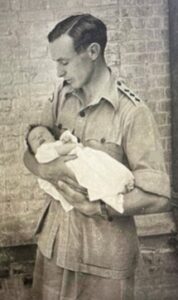
Maurice Newsome holding his son Edward two days after he was born, and just under 4 months before Maurice himself was killed. A year after his father’s death, Edward’s mother changed his name to ‘Maurice Edward’ and he was known as Maurice for the rest of his life.
My thanks to Lucy Inglis, the School Archivist at King’s College School Wimbledon, who kindly provided the text of Hugh Parsons’s letter to Maurice Newsome’s parents and details of his schooldays, to Mrs Angela Newsome Godfrey, Maurice Newsome’s niece, for the newspaper announcement of his death, and to Dorian Leveque of the African & Asian Reference Service at the British Library who provided a copy of Newsome’s burial certificate. The photographs came from the Newsome family archive on Ancestry.com, and I am most grateful to Simon Harris for retrieving them.
JRH
Delhi Day 2026