Echoes of the Raj

The second gathering of Sirmooris at Hurlingham took place on 21st August. John Swanston was in the advance party as usual with Christopher and Griselda and David and Jo Santa-Ollala close on his tail. Sophie Graham and Jon Aslett arrived ‘post-haste’ from Roegate and we settled down to an indulgent lunch at the new ‘Brasserie’.
Mark put us all to shame, by eschewing lunch and joining us only after he had played a game of bowls and a lengthy game of tennis as a warm up! A very spritely Sirmoori, and hardly a ‘sano saheb’ by many years!

Lunch at the Brasserie – Topis at rest.

The Blind leading the Blind

There was some confusion over which ‘stable’ housed the croquet mallets and then as we took to the courts the sun shone on the Sirmoor Rifles!
As a satirical nod to ‘DEI’ Sophie and Griselda chose their teams, with Christopher being chosen only when there were no other options! ‘Sophie’s Choice’ was her father Jon, Mark and John Swanston; with Griselda having David and Christopher in support.

Team Selection

Round 1 saw Griselda and David triumphing over Sophie and the ‘Two Jon/Johns’ by 7-6 having at one point been 4-0 down. But the highlight was John negotiating the second hoop from the first with gay aplomb -a fulsome 25 yard strike. Meanwhile Christopher vanquished Mark 7-3 in singles. (2-0 to Griselda thus far).

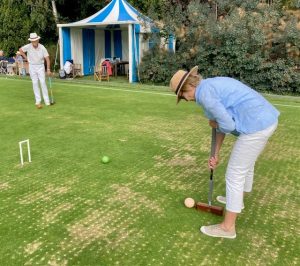
On Court!

Round 2 saw Griselda and Christopher run out winners 7-4 over Mark and John, with Griselda superbly running four hoops, two of which were also over a distance of 25 yards. David meanwhile edged out Sophie 7-6 on the ‘Golden Hoop’ in their singles game (the Golden Hoop is the deciding hoop if both players are equal on 6 points). (4-0 to Griselda)
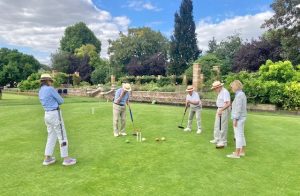
Much Sirmoor pondering…..

And yet more pondering….

Round 3 saw the arrival of reinforcements to Sophie’s team in the shape of her son Charlie, who partnered his grandfather Jon against Griselda and John, winning an exciting game -once again on the Golden Hoop. The highlight was Jon running the 5th hoop at a very fine angle attracting much praise from Charlie ! Sophie’s husband Alistair also then rallied to the cause providing the necessary encouragement for Sophie and Mark to narrowly triumph over Christopher and David – also on the Golden Hoop. The highlight being Sophie’s high pressure strike on Christopher’s ball allowing ~ Mark to run the Golden Hoop and clinch the game. (4-2 Griselda)

Sophie and Mark celebrate their victory !

An exciting finale – and despite the resurgence of Sophie’s team – Griselda’s team came away with the spoils.

A rather long ‘close season’ break now – until July next year.

Jai Sirmoor croquet!

The Nation’s keystone event to mark the 80th anniversary of VJ Day was a Service of Remembrance that took place at the National Memorial Arboretum on Friday 15th August 2025. The occasion was led by His Majesty the King, accompanied by Her Majesty the Queen and associated dignitaries, including the Prime Minister.   The order of service can be downloaded here.

Foremost amongst those attending was a sadly limited and rapidly diminishing number of veterans who fought as part of the 14th Army and its supporting Services.

A limited Gurkha Brigade Association (GBA) contingent, led by John Anderson as acting Chairman GBA. William Shuttlewood (rep 2GR), Louise Anderson (rep 6GR), Heather Willis (rep 7GR), Peter Pearson and Rupert Litherland (rep 10GR) and Rob Cross (rep QGE) also attended. The event was effectively arranged and coordinated by the Royal British Legion. With the Arboretum’s Wall of Remembrance as a stunning backcloth the audience was treated to a 90 minute programme of nostalgic and artistic cameos, the former provided by veterans of the Burma campaign, the latter by individuals drawn from the nation’s arts communities.

The event is available on the BBC’s iPlayer (click here) for those who did not see the live broadcast. It is worth a look. Members of the GBA in attendance would probably agree that the highlights were:

–           The short but clearly very personal address by Capt Yavar Abbas 11th Sikh Regt who, at the age of 104, spoke not only eloquently of his experiences as a “combat Cameraman” during the campaign, but also (off script) of his love and respect for the Monarch and his Queen.

–           Laura Main’s rendition of “When They Sound the Last All Clear”.

–           Vaughan Williams’ “the Lark Ascending” performed by Jennifer Pike.

–           The flypasts by the Red Arrows and the Battle of Britain Memorial flight.

The contribution made by Gurkha Regiments to the success of the Burma campaign was evident throughout the event, with constant references in the script to their fighting prowess. The front cover of the Event Programme includes a contingent of Gurkhas on the march; a contingent of QG SIGNALS formed part of the Guard of Honour; four pipers performed a lament and WO2 Khadakbahadur Chhetri GSPS was filmed laying a wreath at the Sumatra Railway Memorial.   His grandfather, Kalusing Chhetri, was acting Subedar Major of the 2nd Battalion of the 2nd Goorkhas in Japanese captivity in Changi Jail, Singapore: see his biography here.

At the conclusion of the Service members of the GBA contingent withdrew to the Gurkha Chautara where wreaths were laid in memory of the Brigade’s achievements during the campaign and the horrific losses incurred.

In summary, an occasion worthy of the memory of those who fought in Burma and who endured the most challenging of conditions. From defeat to victory.


Throughout most of the 20th century, the ante room of the Officers’ Mess of the 2nd Goorkhas has benefited from the generosity of Brigade Surgeon Lieutenant Colonel William Murphy DSO, courtesy of a fine mantel clock that was presented to the Regiment after he left in February 1898. The wooden case is adorned with an unhallmarked silver plaque with the following charming inscription:

“Presented by Bde Surgeon Lieut Colonel W R Murphy to his brother officers of the 2nd PWO Goorkhas in memory of many happy hours spent with them”

But who was William Murphy? He was born on 23 October 1849 in Ireland. He was educated at Clongowes Wood College, Co. Kildare, Trinity College, Dublin, and the Royal College of Surgeons in Ireland, where he won many prizes during his student course at Meath Hospital.
His first Commission was in the British Army Medical Department in April 1871, where he took 1st Prize and the Herbert Prize at Netley Hospital, Southampton. In 1872, he transferred to the Indian Medical Service, and in October 1875, Murphy’s first appointment was as Officiating Medical Officer to the 20th Bengal Light Infantry. In May 1878, he was transferred to the 13th Bengal Native Infantry before being appointed to the 25th Punjab Regiment Native Infantry.

His first direct contact with the Regiment would have been in April 1878 when he joined the Indian Expeditionary Force ( which included the 2nd Goorkhas ) sent to Malta in response to a possible Russian threat in the eastern Mediterranean. On his return to India in October 1878, he took part in the 2nd Afghan War as Medical Officer of the 19th Bengal Lancers and was present at the action at Saifudin, the occupation of Kandahar, the Battle of Ahmed Khel and the subsequent actions at Arzu and Patkao Shana. In 1880, he was mentioned in despatches for the first time. In 1888, William Murphy served with the Hazara Field Force on the Black Mountain Expedition in the North West Frontier, and was again mentioned in despatches.

In July 1888, he transferred from the 19th Bengal Lancers and was permanently ‘to officiate in medical charge’ of the 2nd Battalion 2nd Goorkhas. He accompanied the 2nd Battalion on the Second Looshai Campaign or the Chin Lushai Expedition of 1888 -90, where he also assumed responsibility as the Principal Medical Officer, for which he was again mentioned in despatches and awarded the DSO ‘ in recognition of services during the Chin-Lushai Expedition ‘ ( London Gazette November 1890 ).

In December 1894, he was switched to the Medical Charge of the 1st Battalion and served with it in the Chitral Relief Force in 1895, but two years later, he left on appointment as Principal Medical Officer of the 3rd Brigade, which included the 1st Battalion as well as the 1st Battalion Gordon Highlanders. He was on the Samana Ridge in 1897 and in Tirah in 1897 – 98, and with the Kurram Kohat Force and present at the action in the Ublan Pass. He was also Principal Medical Officer with the Kurram Movable Column, which included a section British Field Hospital, a Native Field Hospital and a Native General Hospital located at Kohat with 200 beds. He was mentioned in despatches on two further occasions in February and April 1898.

The 1st Battalion’s Digest of Service records that on 2 February 1898, his tenure expired and he was appointed Medical Officer of the 6th Bengal Native Infantry, an appointment he held until his retirement in July 1899, after which he moved to London, where he died on 7 August 1927, aged 78.

The 7-day mantel clock which William Murphy presented to the Regiment was made by Hamilton & Co of Calcutta, who were known as the ‘ Garrard of India ‘because their work appealed to members of the Government, military and Indian aristocracy.  Cones & Co’s Directory and Almanack for Calcutta 1879 described the firm as ‘ Jewellers and silversmiths in ordinary to His Excellency the Viceroy, clock and watch-makers, and dealers in precious stones’.  Their main shop was located at 8, Court House Street, Calcutta, with branches in Bombay, Delhi and Simla.

NB . The clock continues to keep excellent time and is in my possession. This is because I had paid for its restoration in 1977, and the Trustees of the Sirmoor Club kindly agreed when distributing surplus Regimental property for it to be offered to me rather than be put up for auction.

JRH