This apochryphal story appeared in an unauthorised history of the XIth Gurkha Rifles by Lieutenant Colonel H R K Gibbs, late 6GR

Funny things ties. Jolly useful for holding up the odd pyjama, though I hear the subalterns all wear lungis these days . Saw a Yankee fellow wearing an MCC tie the other day ..turned out to have bought it at Tiffany’s in New Amsterdam and didn’t know a googly from a bar of soap. Now, when I was in the Regiment, we didn’t worry too much about ties, far too busy dodging the wily Pathans and the Bhunia with his bills and with damned little chance to wear mufti anyway except when we went poodle faking to the club when the staff wallahs in New Delhi sent their mems up to the hills. Goings on aplenty then, I can tell you, but I won’t – never did hold with telling tales out of mess.

Can’t really remember exactly what the Regimental tie looked like in those days, except that it had to be in colours that came from whatever it was that the planters grew locally – red, green and black I think, or was that the cocktail the griffins had to drink when they were dined in? Anyhow, now that I am retired so to speak. I do wear a tie a bit more often nowadays, old school, club that sort of thing and something that some scoundrel sold me years ago as the tie of the Regiment.

Anyway, one day, a few weeks ago, I trekked down to Hampshire to have a few snorts with old Bletherskite. Bit of a cad, Bletherskite, got posted to the South Waziristan Scouts for slapping the bum of some pretty young wench in Mhow once too often – turned she’d come out with the fishing fleet to marry some Brigadier General in the Jam Stealers. Walking down the street in Fleet, minding my own business, I ran into some fellow whom I had never seen before in my life . Dressed up like a Madrassi remount wallah with a black pullover and one of those hats like the Congress babus used to wear long after my time. Claimed to be an officer of the Regiment, did this chap and asked me where I’d got my tie. Well, after I had damned his eyes for his impertinence, he had the blasted cheek to tell me it was the wrong pattern! Apparently, mine goes left to right, and it should go right to left or some other damned fool nonsense.

Reminds me of the time in Kabul when young Belchworthy of the Bengal Staff Corps wanted to get a cushy posting to Calcutta, so he took to wearing his new-fangled Sam Browne belt ( invented by some counter-jumping wallah ) upside down so they would all think he was mad. Well, all the Generals in Afghanistan were barking anyway, so Belchers had to stay. His next wheeze was to send his Havildar Major up to Dargai to fetch him a black woman. The Haviladar obliged, and Belchers produced a damned toothsome Ghilzai tart at the Resident’s Ball next month. He got his posting all right, but the bibi married a Colonel of the Guides, became Lady Snipefoggers and wife of the Lord Lieutenant of Devonshire. Nobody minded much then, after all, Wheeler married a black Maharani.

Returning to ties …I went to the Reunion a few months ago – didn’t know anybody but had a good shufti around. It’s all different now. They don’t send the inlying piquet into the Ghussalkhana at first light anymore. In my day, there would have been a damned great Kabuli with a Khyber knife ready to whip your whatsits off if you neglected that sort of elementary precaution. We had a talk at the AGM by some whippersnapper dressed up like a French dancing master who said that most of our ties were the wrong pattern. In my day, the lad would have known that his seniors are always right and he would have nipped off and bought one of the same as ours sharpish. I didn’t really follow the story, but it seems that some archaeological excavation in Salisbury or somewhere had opened up a long barrow and found four empty bottles of rum, a losing betting ticket for the 1818 Derby and a skeleton clutching a Weobley and wearing a Regimental tie. Apparently, this was the mortal remains of young Crutchley, who had gone on long leave ( once every seven years if you can raise the price of a P&O ticket ) and never came back. We always thought the young blighter had shipped on a West Indiaman and was living the life of Riley on a sugar plantation with half the darzhis of Calcutta bemoaning unpaid bills. The truth apparently was that he‘d had a tip from some mountebank in the Life Guards for a three-legged congenital no-hoper in the Derby and had stuck the family silver and his younger sister’s dowry on it. When the uneducated dwarf riding the beast had failed to oblige, Crutchley did the decent thing and blew his brains out, but without first removing his Regimental tie – which just shows that you can never trust an Old Marburian.

The point of all this is that young Crutchley’s tie is the oldest known specimen of the thing, and the black and green stripes are three-quarters of an inch wide, and the red is one-tenth. Apparently, we old buffers are all going to have to buy new ties and allow the box wallah who makes the damned things to light up another fat cheroot . Shan’t bother myself . Funny things ties.
MAJOR JOHN HERRICK

A Sirmoori and First World War veteran who enlisted in Canada and lost his life in Iraq in 1920, and has been commemorated on four memorials.

Major John Riversdale Warren Herrick was born on 22 May 1893, the eldest son of Dr Robert and Mrs Edith Herrick of 30 Regent Street, Nottingham. His younger brother, Captain Robert Lysle Warren Herrick, served in the 29th Lancers Regiment ( Deccan Horse ) and was awarded the DSO for an action against the Turks that took place on 21 August 1918 in the vicinity of Wadi Nimrin, a bridgehead over the River Jordan.

John Herrick was educated at Nottingham High School and, on leaving school in 1910, aged 17, he worked as a bank clerk in Nottingham.  He represented the Old Boys in the first-ever competitive rugby match played by Nottingham High School on Boxing Day 1913.

At some stage during 1914, he went out to Canada.  After the start of the First World War, and in response to a call to arms by the Dominions, he enlisted on 23 September 1914 at Valcartier, Quebec, as No 260 Private Herrick in the 8th Battalion, Canadian Infantry ( later to become 90th Regiment Winnipeg Rifles ) of the Canadian Expeditionary Force. His attestation papers described him as being 5ft 11ins tall and his occupation as a storeman. He sailed to England with the Battalion on 3 October 1914 in the SS Franconia.

However, John Herrick must have impressed his superiors, because very soon after having returned to England, he was discharged from the Canadian Infantry on 15 November 1914 to join The Territorial Force for ‘a commission in the Imperial Army ‘.  This was confirmed by a notification in The London Gazette dated 4 December as his being gazetted as a Second Lieutenant in the Nottinghamshire Yeomanry ( Sherwood Rangers ).  His name appeared subsequently in The Army List in the 2nd Sherwood Rangers, which was a Second-Line mounted regiment ( 2/1st Sherwood Rangers Yeomanry ) of The Territorial Force responsible for home defence.  In August 1917, the regiment converted to a cyclist unit and, in early 1918, was located in Canterbury.

Around this time, John Herrick, by now an acting Captain, and presumably having avoided being sent to the Western Front, was transferred on 12 January 1918 to the Indian Army on probation, but forfeiting nine months’ seniority under Indian Army Order 511/1917. He was posted to the 3rd Battalion 2nd Goorkhas, who were stationed in Peshawar on the North West Frontier. This was a testing time for this newly formed battalion, not least for the reasons described in the Regimental History Volume II:

‘It cannot be said that the 3/2GR had the appearance of an old Battalion, as many changes had a naturally disturbing effect. Although the number of officers had been considerably increased by officers on probation for the Indian Army, they had had no previous experience with Indian troops and were ignorant of the language, and their value to the newly raised Battalion was at first not great.’

Indeed, John Herrick was soon to find himself promoted to Acting Major and appointed as Battalion Second-in-Command until August 1918. The 3rd Battalion was bitterly disappointed by not being deployed to fight in the Third Afghan War (May – August 1919 ). Instead, it was ordered to remain in Peshawar on internal security duties until February 1920, after which the Battalion returned to Dehra Dun before its disbandment later that year.

Meanwhile, in June 1920, and in response to the Arab Rebellion which had broken out in Iraq ( formerly known as Mesopotamia ), the 1st and 2nd Battalion 11th Gurkha Rifles were hurriedly sent out to the British-occupied area of Iraq, which was where they had originally been formed in 1918.  The 11th Gurkha Rifles had been raised as an ad hoc unit in 1918 in Mesopotamia with troops and officers being drawn from other Gurkha regiments, and it comprised four battalions. All had fought in Mesopotamia, and at the end of hostilities, they were deployed to the North West Frontier and took part in the Third Afghan War before their eventual disbandment in late 1920.

Sometime after July 1920, John Herrick was seconded from the 3rd Battalion 2nd Goorkhas to the 1st Battalion 11th Gurkha Rifles, now located in Iraq, where he was to experience some fierce fighting against the rebel forces led by Sheikh Mahmud Barzanji. The campaign was to be short-lived, and both Battalions were to soon return to India for disbandment, but not before John Herrick had tragically died of wounds on 24 October 1920, allegedly caused by being hit by a spent bullet during operations in British-occupied Iraq.

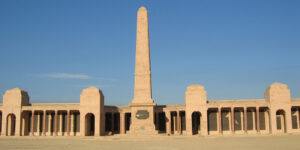
He is buried in the Commonwealth War Graves Commission Basra War Cemetery, Iraq. Plot II, Row K, Grave 14.

Commonwealth War Graves Commission memorial at Basra

He is also commemorated on three other memorials, but curiously not on the 2nd Goorkhas First World War brass plaque, which was originally dedicated in St Thomas’ Church, Dehra Dun.

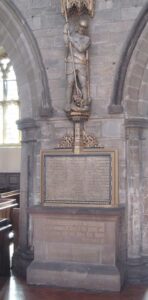
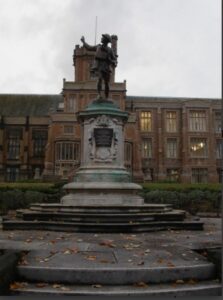
● Nottingham High School – War Memorial.  The memorial is a statue of a life-size figure in bronze of a young second lieutenant in service dress uniform leading his platoon in the attack. The names of those who died are inscribed on two bronze panels. The sculptor was Henry Poole ARA.

Nottingham High School Memorial


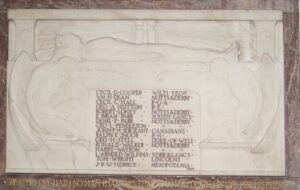
● St Peter’s Church, Nottingham.  The memorial, which was originally dedicated in St James’ Church, Nottingham, was transferred to St Peter’s Church in 1933. The names are inscribed in red on a white marble tablet below the naked body of a young man who is lying on his back.  Behind him is a Cross and two angels. The memorial was designed and executed by Robert Wilson, who was a teacher at the Nottingham School of Art.

The Memorial in St Peter’s Church, Nottingham


Close-up of the inscription on the memorial

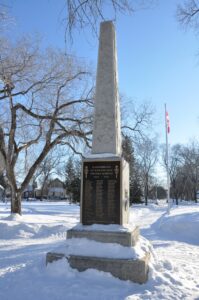
● Transcona Cenotaph, Memorial Circle Park, Winnipeg, Canada.  The memorial comprises a roughly finished grey granite obelisk, 14 feet in height, and is placed over a smoothly polished granite base inscribed with 62 names. It was made by the Memorial Marble and Tile Company of Winnipeg and was erected in 1931. The memorial was relocated to its present site in 2001.

The Transcona War Memorial

John Herrick had the following medals: British War Medal 1914 – 20, Victory Medal 1914 – 19, General Service Medal 1918 – 1962 with clasp IRAQ.

He never married.

JRH