
After the Third Afghan War ended on this day both the 2nd and 3rd Battalions were awarded the India General Service Medal 1908-35 with clasp ‘Afghanistan N.W.F 1919’. 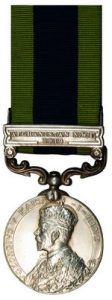 The 2nd Battalion was part of the Waziristan force based at Dera Ismail Khan. The 3rd Battalion was based in Peshawar and mostly carried out internal security duties there, but also sent several detachments to the border.
Subedar Kalu Sing Chhetri was awarded the Military Cross for his courage and devotion to duty when acting as Subedar-Major of the 2nd Battalion during the withdrawal in Malaya. Click here to read the citation for his award.
Havildar Dewat Pun was awarded the Military Medal for his leadership, initiative and courage during the 2nd Battalion withdrawal in Malaya. Click here to read the citation for his award.
D Company under Major Nick Neill laid an ambush in Malaya, remaining in place for six days until on 10 June two Communist Terrorists appeared and were killed. A further three more were killed on 10 July and four more on 8 August, three of whom were shot by Neill himself.
B Company of the 2nd Battalion under Major Nick Neill attacked a Communist Terrorist camp. Seven enemy were killed for the loss of two Gurkhas.
>
A newsletter published by the Regimental Centre in Dehra Dun reported that Naik (Corporal) Chandrabahadur Gurung of the 2nd Battalion, who had lost a leg in Malaya, celebrated his recovery by taking a second wife (kanchi swasni) on the proceeds of his disability pension, as his religion and Nepalese custom permitted. He left for Nepal on crutches, the junior wife carrying his false leg under her arm.
Lieutenant ‘Dan’ Turner had a brief yet notorious career in the 2nd Goorkhas. He joined in 1890 and married a lovely young woman with a beautiful singing voice. He built her a large house with splendid acoustics in Dehra Dun and they entertained lavishly, but he greatly over-extended himself financially. His wife returned to England. He was given long leave to sort out his affairs, but in February 1896 had to resign his commission in disgrace and ‘slipped away quietly’, managing to board a boat in Bombay just ahead of his many creditors, never to be heard of again.
The 5th Battalion was raised in March 1942. They were initially allocated some motor transport but in September this plan was changed and they were allocated fewer vehicles and given more mules. From a safety point of view this may not have been a bad thing. One officer recalled:
‘[Our] transport comprised twelve bazaar buses with gaily coloured wooden bodies insecurely attached to antique Dodge lorry chassis. Starting involved an old bearded man wearing a dhoti pouring some liquid from a small tin over the engine, which then appeared to burst into flames before it erupted into shuddering life’.
Major General Godfray Hind, a former officer of the Regiment, visited the 1st Battalion at Slim Barracks in Singapore. He later reported that he met ‘two Gurkha officers of my vintage who welcomed me as only a Gurkha can. One of them showed me a scar on his chest bone some 2 inches in diameter where a bullet had hit him in Brunei and bounced off. He was, as I guessed, a Pun. When I asked if he was now going on leave to Nepal he replied very forcibly ‘No sahib, not until I have gone back to Brunei to get that man who fired at me!’.
Major Charles Reid, commanding the Sirmoor Battalion on the Ridge at Delhi under heavy fire from the rebel forces, wrote ‘I only wish the rascals would give us time to put on a clean shirt; I have not had one on for three days, which is by no means pleasant in such weather as this. Obliged to be on the alert morning, noon and night.’