
THE SIRMOOR COLOURS
by Major JR Harrop
Before the award of the Queen’s Truncheon in 1863, the Regiment possessed two sets of Colours. Each pair comprised a Sovereign’s Colour and a Regimental Colour.
The earliest pair dates from 1844 to 1850, and they were carried into battle during the First Sikh War (1842 – 48), specifically at the Battles of Aliwal on 28 January 1846 and Sobraon on 10 February 1846. According to the official report by Lieutenant General Sir Harry Smith GCB Bt, reproduced in the History of The 2nd King Edward’s Own Goorkhas, Volume I, the following incident occurred during the Battle of Aliwal:
“Here the colours of the Sirmoor Battalion were almost shot to pieces; the staff of the King’s Colour was cut in half by a cannon ball and was spliced in the field, while a little later the black Regimental colour was temporarily captured, the Goorkha officer carrying it being killed. At once a party of Goorkhas, under Havildar Badal Sing Thapa, sprang forward and with great gallantry cut their way amongst the enemy, recovering the colour but not the staff. This was replaced by bamboo cut in the field.”
Comment. As the Sovereign’s Colour was apparently awarded in 1844 during the reign of Queen Victoria, it is unclear as to why it is referred to as the King’s Colour, because it should be the Queen’s Colour.
This damaged set was replaced in 1850, and the new Colours were carried throughout the Siege of Delhi, and on 17 June 1857 the following incident occurred and is recorded in the History of The 2nd King Edward’s Own Goorkhas, Volume I:
“ From the Mori Bastion, heavy guns daily pounded the main piquet ……and one round shot, piercing the front wall of Hindoo Rao’s House, killed Ensign Wheatley; wounded nine Goorkhas and cut the staff of the Sirmoor Regimental Colour in two.”
Ensign Charles Wheatley, 54th Native Infantry ( which had mutinied at Delhi ), had volunteered and received permission to join the Sirmoor Battalion. He was aged 24 and present throughout the Siege until he was killed by a 32 -pounder shell which burst onto the back verandah of Hindoo Rao’s House.
In recognition of their distinguished service during the Indian Mutiny, the Sirmoor Battalion was granted the honour of carrying a third Colour and authority for an extra jemendar to be added to the establishment. This was confirmed in the General Order of the Commander in Chief No 379 dated 4 September 1858 as follows:
“ In acknowledgement of the distinguished services of the Sirmoor Rifles before Delhi, the Right Honourable the Governor -General in Council is pleased to confer on that Regiment the privilege of carrying colours similar to those of line regiments, as well as an honorary colour, on which the word ‘Delhi’ shall be inscribed in Persian, Hindi and English ”
At the same time, the name of the Regiment was changed from that of Sirmoor Battalion to Sirmoor Rifle Regiment, but for some reason, this Honorary Third Colour was never knowingly made. This may seem a curious oversight because it would have been reasonably straightforward for local Indian craftsmen to make an appropriate embroidered Colour. Besides, the Bengal Native Infantry regiments all followed British military traditions by having three sets of Colours comprising:
- Union Flag
- Honourable East India Company coat of arms
- Regimental ( with a Union flag in the top left-hand corner )
Maybe the decision not to commission this third Colour rested with General Sir Charles Reid GCB, who had commanded the Sirmoor Battalion with such distinction during the Indian Mutiny, and later in the subsequent Oudh Campaign 1858 -59. He did not relinquish command until 1861, when he had to return to England on medical grounds for 15 months. It is likely that at some stage during his tenure of command Charles Reid had the idea for a truncheon to replace the Honorary Third Colour.
Although HRH The Duke of Cambridge, Commander in Chief of the British Army, would not recommend a truncheon as a Third Colour, he did not object to a truncheon being carried by the Bugle Major at the head of the Regiment as a mark of distinction. The Officiating Secretary to the Government of India wrote in a letter No. 1428 dated 28 October 1859:
‘ The Government ( ie the Government of India ) is accordingly pleased to authorise a bronze truncheon, in the shape of a Drum Major’s stick, to be made up and presented to the Regiment .’
Once in England, Charles Reid further developed his idea and personally designed a special truncheon that would be suitable to replace the Honorary Third Colour. Furthermore, as he was someone who was persona grata at Court, he had little difficulty in circumventing the Duke of Cambridge and was able to submit his proposal to Her Majesty Queen Victoria. She gave her approval, and the Queen’sTruncheon was manufactured by the prestigious firm of jewellers and silversmiths, Messrs Hunt & Roskell ( who held the Royal Appointment to Queen Victoria) in London. In due course, it was sent out to India and officially presented on 30 November 1863 to the Regiment by the Commander-in-Chief, Lieutenant General Sir Hugh Rose ( later Lord Strathnairn) at Lahore.
As the Regiment had been granted the honour of becoming a regular rifle regiment, it was no longer permissible to carry Colours, but it now had the unique distinction that the old Colours had been replaced by the Queen’s Truncheon. It is not known exactly what immediately happened to the redundant Colours. They might have been hung in the Officers’ Mess. Yet it is unlikely they were laid up in St Thomas’s Church, Dehra Dun, because thirteen years later the Adjutant General authorised in his letter No. 1299-D dated 3 March 1876 a formal handover of the Colours to Charles Reid, who by now was living in London.
In 1895 he presented the two sets of Colours to the Royal United Services Institute,61 Whitehall, London SW1, which in those days incorporated a museum and was a popular attraction for visitors. In 1902, King Edward VII, as Honorary Colonel of the Regiment, gave specific instructions that the two sets of Colours be temporarily taken from the RUSI museum and carried on a special parade to be held on 13 August 1902 at Buckingham Palace, a few days after the main Coronation parade. This parade comprised a contingent of more than 1000 soldiers representing 44 different regiments from the Indian Army, including the 2nd Goorkhas, and here are two of the somewhat jingoistic accounts:
‘Then was seen for the first time that the Goorkhas were carrying once more their battered and blood-stained Colours, which for almost forty years have reposed in the care of the Royal United Servicrs Institution…faded and dim were these battle standards, but round then cling traditions which thrill the hears of the heroic Goorkhas, of whom none of the present generation ever before beheld the flags, which waved above their predecessors at Aliwal and Sobraon …both were perforated with bullets and stained with blood ….and when the Troops presented arms, the Colours were lowered in salute to His Majesty, and the time-worn and blood-stained hue of the King’s Colour and the inky black of the Regimental one recalled the many sanguinary conflicts above which thy had waved ….” Daily Telegraph
NB: Note again the incorrect description of the redundant Sovereign’s Colour awarded during the reign of Queen Victoria as the ‘ King’s ‘ Colour.
‘The most picturesque incident in that brilliant march past, the passing of the ancient Colours of the 2nd Goorkhas …they carried two sets of scarred and battered ribbons on poles ….what a record of heroism lies wound among the blackened silks of those Colours ….and is it to be wondered that every hand was raised in mute salute when those war-scarred harbingers of victory were carried past the King…” The Times
There is a photograph of Captain H D Watson ( later Major General Sir Harry) holding a Queen’s Colour and Captain Donald Watt ( later Brigadier General ) holding a Regimental Colour in London on the occasion of the parade.
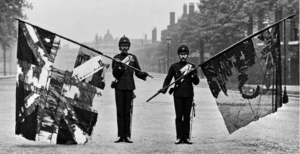
After the parade, the Colours were returned to the RUSI Museum until the lease expired in 1960, and all the contents were dispersed. The 2nd Goorkha Colours went to the museum of the 60th Rifles in Winchester, but not for long, because under the vision and leadership of Field Marshal Sir Gerald Templer, the nascent National Army Museum(NAM ) had recently been established at the old Riding School at the Royal Military Academy, Sandhurst. In due course, the Colours were taken from Winchester to Sandhurst and, in August 1961, became the property of the National Army Museum. In 1971, the NAM was officially opened by HM Queen Elizabeth II in its present location in Chelsea, but the Sirmoor Colours were not selected for display and instead were stored in the NAM’s off- site and state-of-the-art store in Stevenage.
In the early 1990s Field Marshal Sir John Chapple and Colonel Denis Wood approached The Royal School of Needlework to commission a major restoration, but the Colours being in such delicate condition the estimate was too great, and besides, there was insufficient space to display them in the new location. It was therefore decided that the Colours should remain as part of the NAM’s permanent collection.
Earlier this year, the Head of Collections Standards and Care at the National Army Museum kindly arranged for the Colours, which by now are even more fragile, to be professionally photographed.
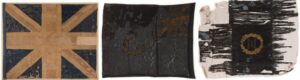
However, this has resulted in something of a mystery concerning one of the two Regimental Colours, and not the one being carried by Captain Donald Watt in the 1902 photograph. As can be clearly seen, the recent photograph of the other Regimental Colour has the wording SURMOOR LIGHT INFANTRY embroidered within a wreath.
The late Field Marshal Sir John Chapple took a keen interest in Gurkha regimental lineage, and the Gurkha Museum published his research. However, the Regiment never had the title ‘ Sirmoor Light Infantry’and certainly never when the Colours were first presented during the 1840s. The only somewhat spurious assumption is that a Commanding Officer, possibly Major Francis Evans, who assumed command of the Sirmoor Battalion on the death of Captain John Fisher at the Battle of Sobraon in 1846, might have himself designed the Colour? He had served in the 26th Native Infantry, and after he had relinquished command of the Sirmoor Battalion, a rectangular brass plate with the inscription ‘ 26 LIGHT INFANTRY’ belonging to him was left behind.