
Lieutenant Colonel Lalbahadur Pun OBE MC

Lieutenant Colonel Lalbahadur Pun at the 2004 Durbar Parade in Nepal
Lalbahadur was born on 17 November 1937 in the village of Shikha in Myagdi district in Nepal, the son of Captain (GCO) Tikajit Pun MBE OBI IDSM. He was educated at St Joseph’s School, Dehra Dun, India.
After service in the ranks, Lalbahadur was one of the first Gurkhas to be selected for training at the Royal Military Academy Sandhurst. Gazetted to the 2nd Goorkhas, he joined the 1st Battalion in the Far East in 1960 after attending young officers’ courses in the UK
He was ADC to Major General WC Walker from 1963 to 31 March 1965. Walker, who at that point was General Officer Commanding all British Forces fighting the Indonesians in the Borneo Confrontation, was a hard taskmaster and a tough, very experienced soldier. It is testament to Lalbahadur’s equally strong personality and character that he survived two years as Walker’s ADC.
Lalbahadur was appointed OC D Company in early 1965 and moved with his company less one platoon to a company base at Long Pasia in the Interior Residency of Sabah. During the last week of September he led a successful action against an Indonesian military camp, described in the Regimental history ‘Remarkable Times, Remarkable Men’:
‘Another cross-border operation took place in September 1965, this time by two platoons of D Company of the 1st Battalion under Captain Lalbahadur Pun, a Sandhurst-commissioned Gurkha with strong family connections with the Regiment. They were on patrol in the Labang area on the Indonesian side of the border south of Sabah, following intelligence reports that a sub-unit of Indonesian paratroops were in the area. On 25 September they picked up fresh tracks of a force some 60 strong which led them to the banks of the Sungei Sembakong, the main communication route between the Indonesian forward bases and their headquarters and supply depots in the rear. There was good visibility along and across the wide river, and after three hours about 1,500 yards away they spotted four boats disembarking 25 men and picking up another 18. Moving through difficult terrain towards the area they did not initially find the camp and spent a miserable night in the jungle in heavy rain, with no possibility of cooking or eating in case they gave their position away. The next morning they moved off and after two hours discovered a camp containing 60 Indonesians. The terrain did not permit a cut-off to be put in place, so he simply led his men in an attack. Taken completely by surprise, at least 13 were killed and the remainder fled. 25 enemy weapons were recovered as well as documents.’
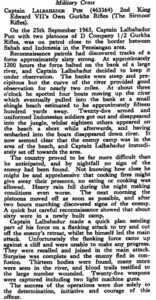
Lalbahadur was awarded the Military Cross for leading this action, the citation for which is shown below.
At the end of Confrontation in 1966 D Company was temporarily disbanded for lack of soldiers, but reformed in Tuker Lines, Seria, Brunei, under Lalbahadur’s command on 29 December 1967. In late 1969 he left the Battalion to attend Staff College at Camberley., the first Gurkha to do so. The Daily Telegraph reported the event with a paragraph headed ‘Visit with a Purpose’.
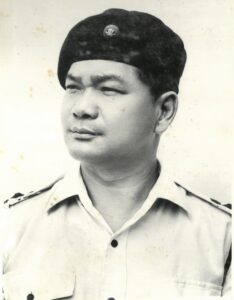
Lalbahadur Pun in 1970 (2GR Regimental Archives courtesy of the Gurkha Museum)
He was GSO2 Training/Air HQ British Forces Hong Kong from 16 January 1971 to 8 February 1973. He subsequently commanded A Company of the 1st Battalion in Brunei and found the Guard for the Queen’s Birthday Parade held in June 1973 in Bandar Seri Begawan. From 15 July 1974 to July 1975 he was Training Major (Chief Instructor) at Tutong Training Camp in Brunei, which was then the British Army Jungle Warfare Training School. On 14 June 1975 he again commanded the Guard for the Queen’s Birthday parade.
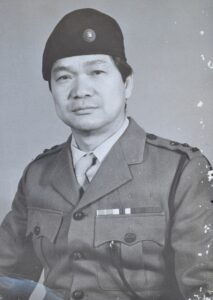
Lieutenant Colonel Lalbahadur Pun shortly after he was Commandant of the Training Depot Brigade of Gurkhas
During his time in the Battalion he was highly regarded as a trainer and in August and September 1975 organised and ran a leadership course in Brunei for young officers from across the whole of the Brigade of Gurkhas. He is widely remembered as extremely supportive of new officers, providing much useful advice and guidance on how to run their commands and operate in the jungle. Known by his nickname ‘Bhalu’ [‘Bear’ in Gurkhali] he was an a strong and fearless sportsman although his footballing skills were notable for their enthusiasm and energy rather than accuracy.
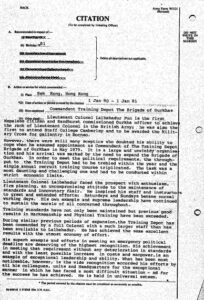
Lalbahadur was promoted to Lieutenant Colonel, the first Gurkha to achieve this rank, and was Commandant of the Training Depot Brigade of Gurkhas, Hong Kong, from 20 April 1979 to 18 October 1981. During this time the Brigade was significantly expanded to cope with very large increases in illegal immigration into Hong Kong by Vietnamese arriving in boats and Chinese crossing the Sino-Hong Kong border. His achievement in very quickly doubling the number of recruits that were trained and delivered to Gurkha battalions was marked by the award of the OBE.
After appointments as Deputy Commander Support Troops in Hong Kong and Chief Instructor at the Small Arms Wing of the School of Infantry in the UK, Lalbahadur retired from the Army in 1988. In early 1989 he joined the Sultan of Brunei’s Gurkha Reserve Unit (GRU) as a battalion commander. He retired from the GRU in 2000 to live in Kathmandu.
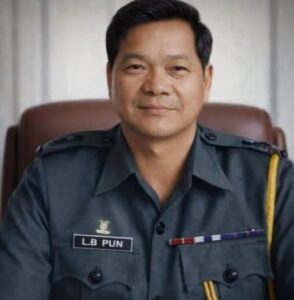
Lalbahadur as a battalion commander in the Sultan of Brunei’s Gurkha Reserve Unit
He died on 9 January 2026 in the Hospital for Advanced Medicine & Surgery in Kathmandu after several years of brave struggles with medical issues and dementia, during which he made every effort to continue attending Regimental gatherings and reunions.
He married Sara Punini in 1965 and had two sons and two grandchildren.
Citation for his Military Cross (London Gazette Supplement 24th May 1966):
Citation for his OBE (London Gazette Supplement 13th June 1981):

His Times obituary can be read here and his Daily Telegraph obituary is here. Please click here to read a report on a memorial service held for him at the Gurkha Memorial Museum Pokhara on 23rd February 2026.
When he died, several former colleagues paid tribute to him:
Captain (QGO) Bharat Singh Thapa Chhetri, Chairman of the Sirmoor Club Nepal
I regret to inform you of the passing of Lt Col Lalbahadur Pun OBE MC at the HAMS Hospital in Kathmandu, earlier this morning (9th January). He was 89 years old. He had been in and out of the hospital a number of times in the last two months. Recently he developed some problems in his lungs for which he was admitted to HAMS two weeks ago. They also detected some heart-vessels problems.
Although he had been experiencing a gradual decline in his mental abilities for the last few years he still enjoyed meeting and conversing with people he had worked with. His funeral rites took place at Pashupati Arya Ghat attended by large number of veterans, relatives and friends who gathered to bid final farewell to this legendary officer.
I remember three stories relating from his time in command of D Company of the 1st Battalion which show how he always had the interests of his soldiers at heart:
- Battalion headquarters sent a message to Lalbahadur: ‘Your company fund is very low; why?’. He replied ‘sipahiko paisa sipahile khayo’ (it’s the soldiers money and the soldiers have used it’). There was no further inquiry!
- In Queen’s Hill Camp in Hong Kong, Lalbahadur’s company kept a pet deer called Singbahadur Pun. It wandered freely around the lines and the soldiers used to give special food like cake and sweets. Such was Lalbahadur’s authority and standing that nobody dared complain!
- A helicopter doing the ration resupply dropped a large bag of meat at the D Company location. Knowing the other companies needed the protein just as badly but weren’t going to get any, Lalbahadur he forcefully persuaded the pilot to land again, pick up a large proportion of the meat and take it to the other company locations.
Major (GCO) Lalbahadur Gurung
I remember hearing in a BFBS interview he gave some years ago that he was a late starter at St. Joseph’s School, Dehradun where he went from his remote Pun village of Sikha. On graduation from St. Joseph’s he was offered a scholarship for Physics/ Maths degree from the all-India Patna University, but for family reasons opted to joining the British Army in the footsteps of his father, the famous Tikajit Pun. His younger brother, Santa Pun, had graduated from St. Xavier’s Godavari in Kathmandu in around 1958/59, and later on qualified as an Electrical Engineer in Pakistan & became the head of the Nepal Bidhyut Bibhag (Nepal Electricity Authority) in which role he had to bear the full brunt of the Load Shedding under the deeply corrupt politicians at that time.
When Col LB Pun joined the 1st Battalion from Sandhurst his physique made him look like a 1st Division player. The Officer in Charge of our battalion team gave him a trial, but he turned out to be a ‘GHUNDA-THOKUWA’ (knee-jerker) [= inaccurate shooter]. So, he had to be turned away for the morale of the team and more importantly for the name of the Battalion at a time when the Nepal Cup [the Brigade of Gurkhas inter-unit football competition] was considered to be on par with the World Cup.
Brigadier Christopher Bullock OBE MC
Being in different battalions I saw Lalbahadur but infrequently and mostly whilst he was Walter Walker’s ADC and we were in Slim Barracks [in Singapore]. Later when he was commanding TDBG and I was commanding 6GR our married quarters were close and Liz and I saw a lot of Lalbahadur and his delightful wife Sara who were very hospitable and great company.
Brigadier Bruce Jackman OBE MC
This is very sad indeed. LB was a terrific friend when I first joined 1st Bn in 1992 and throughout our service together. He was a real character and always full of good humour. A real loss. I am almost certain, he won the Maths & Science Prize at Sandhurst. He was exceptional.
Lieutenant General Sir Peter Duffell KCB CBE MC
I was most sad to learn of the death of LB. He was pretty much of my generation; we were company commanders together and good friends during Confrontation. His D Company out of Long Pasia performed gallantly during Claret operations where he gained his Military Cross. A fellow Pun, Thandraj Saheb was his admirable 2IC. By all accounts he was also an excellent ADC to General Walter Walker and lived to tell the tale. No mean feat. Later on he commanded the Training Depot with much distinction. He was. I think, the first Gurkha to go to Sandhurst passing out with John Parkes [Colonel J L Parkes OBE, late 2nd Goorkhas] who won the Sword of Honour. I visited LB and his delightful wife Sara at his home in Kathmandu in 2018 and we had an agreeable and happy lunch together. He followed his most distinguished Father, Captain Tikajit in leaving a gallant and indelible mark on the history of our Regiment. He was an outstanding Officer.
Brigadier IA Ridgen OBE (President of the Sirmoor Rifles Association)
I know he had not been well in recent years but it is still a shock to lose such a respected Regimental character of an important era in our history. He was very much a trailblazer and had a very distinguished service. I had the honour of meeting him a number of times over my career and remember each occasion fondly.
Colonel NJH Hinton MBE
It is very sad that LB has passed on. I had some dealings with him in the late 70s when he was Commandant of TDBG and I was Adjutant of 2/2GR, and was hugely impressed by his energy and sense of purpose. He well deserved his OBE for all the fine work he did to increase recruit throughput at the Depot. He achieved so much and contributed a huge amount to the Regiment and the Army. It was a life very well-lived.
Major DL Thomas MBE
LB had such a distinguished career. The son of an equally acclaimed Sirmoori, commissioned at RMAS at the same time as John Parkes, winner of an MC and awarded an OBE and the first Gurkha to be appointed Lt Col. He bridged the cultures between East and West and took both forward in a way that many would have wished they could also do so effectively. Everyone loved LB no matter how well they knew him. Always ready to help, always cheerful, a great leader and a fine Sirmoori in a regiment of many fine men. We mourn his passing but we must also think of LB’s many successes and achievements and are so glad that he has been part of our world, and us a small part of his.
Major JR Harrop
I did not know him well, but remember he was a man with a formidable presence.
Major Yambahadur Gurung BEM
We have lost a really remarkable Gurkha figurehead we all admired.
Colonel Denis Wood MBE
I was Battalion Second-in-Command when Lalbahadur won his MC. I remember him telling me that they were guided to the Indonesian camp by the tantalising smell of roasting pig, which after a night in the rainswept jungle without food acted like a magnet to Lalbahadur and his hungry Gurkhas. (History does not relate whether the Gurkhas ate the pig they found, but in all probability they did!).
Captain (QGO) Raju Pun, Chairman of the ‘Sirmoor Sathies’ in the UK
Lieutenant Colonel Lalbdr Pun OBE MC was a remarkable person who touched the lives of many in 2GR, the Hong Kong Volunteers Services unit [when he was Deputy Commander of Support Troops in Hong Kong] and the Gurkha Reserve Unit. We shall always remember him. His presence enriched our lives, and I am grateful to have had the privilege of knowing him when he was OC A Company 1/2GR in 1977. Words can hardly provide comfort when faced with such a tremendous loss. Our thoughts and prayers go to Lt Col LB Pun Saheb Family members and will be dearly missed but fondly remembered. Rest in Peace Colonel Saheb and Lali Salaams!!
Colonel David Scotson late 2GR and former Commander of the Gurkha Reserve Unit
between joining the 1st Battalion in 1964 and leaving the GRU in 1997 I had many dealings with LB and greatly admired him. He was known as Bhalu [‘bear’]. The name suited him admirably. As a new and inexperienced company commander during Confrontation I particularly sought his advice on how to run my company and operate in the jungle. Decades later when he ran the training for the GRU he had lost none of his panache.
Colonel CP Lavender MVO
We are very saddened to hear this news – I knew LB was not well -but not that the end was near. He and Sara were very welcoming when we arrived in the 1st Battalion. He also entertained us when he was with the GRU in Brunei– and finally in Kathmandu – but many years ago now.
Colonel WF Shuttlewood OBE, Chairman of the Sirmoor Club
Reading these citations for Lalbahadur reminded me of why I wanted to join the Army.
Colonel RL Litherland late-10GR
I was Brigade Major in HQ Brigade of Gurkhas in 1981. At that time we were the superior headquarters for the Training Depot, 2/7GR and the Brunei Battalion in a bizarre short-lived command arrangement. As such I had worked extensively with LB when he was commanding the Depot, work for which he very definitely deserved the OBE. I subsequently had a number of dealings with him when I was Garrison Commander in Brunei and he was with GRU. He was a character and a wonderful soldier.