
As an alternative asset class in a year when the FTSE 100 was up 21.5%, medals and military-themed art with a Gurkha connection held up reasonably well, but failed to deliver the remarkable returns enjoyed by silver ( + 150 % ) or gold ( + 65 %). Please note that this article does not refer to those items which were available for sale through dealers or via the internet.
Medals
Amongst campaign medals sold at auction last year, which were awarded to soldiers of the 2nd Goorkhas, there was an example of an Indian General Service Medal 1854 – 95 Clasp N E FRONTIER to a Jemedar ( name illegible ) and an Indian General Service Medal 1908 – 1935 Clasp ABOR 1911 -12 to Naik Surbir Gurung 1/2GR. However, the standout group was that which included an immediate award of the Military Medal to Naik Krishanbahdur Gurung 1/2GR at the Battle of Monte Cassino on 18 February 1944. He was later promoted to Halvidar, but sadly died on active service in Italy on 9 September 1944.
( Hammer price £1200 ). Extracts from his citation:
‘ On the night of 18th February 1944, while forming up his section in difficult conditions, several enemy automatics opened up over a very short range, and grenades were thrown. Every man in the section was either killed or badly wounded, Naik Krishanbahdur Gurung himself receiving a severe wound in the face. Despite this, he fired his Tommy gun and threw grenades, which silenced the enemy fire. He then joined his platoon commander – also wounded – and with a handful of survivors advanced under heavy fire. When the order to consolidate came, and although in great pain, he assisted the platoon commander in organising stretcher parties. He refused to be evacuated himself until ordered by his platoon commander about 5 hours after being wounded. His determination to advance and destroy the enemy was an inspiration to all, and his cool courage under heavy fire was unsurpassed.’
Another group was the medals of WO2 Tejbahadur Gurung 1/2GR which included a General Service Medal 1918 -1962 Clasps MALAYA and BRUNEI with MID awarded during the Malayan Emergency and a scarce Commander-in-Chief Commendation for the period up to 31 May 1954. The London Gazette dated 1 June 1953 states:
‘ In recognition of gallant and distinguished services in Malaya, during the period 1 July 1952 to 28 February 1953 ‘
Hammer price was £850.
Finally, the Gurkha Museum acquired, with the help of two generous donations via the 7th Gurkha Rifles Regimental Association, the pair of medals, including the Military Medal awarded to Cpl Bombahadur Limbu 1/7GR, who was a leading scout in a contact which took place on 18 March 1965 during the Borneo Confrontation. Hammer price was £4600.
Art
Paintings with a Gurkha or Indian Army association also commanded a modest premium, as can be seen from the following lots, which were sold last year:
• One of the two prints of an Assemblage of Gurkha Hillmen from James Fraser’s Views in the Himalaya Mountains ( Hammer price £800 ).
• Print Incident in the Subzee Mundee 1857 ( One of eleven prints) (Hammer price £1100 ).
• Portrait miniature of Major General Sir David Ochterlony Bt GCB by Robert Home ( 1752 – 1834 ) ( Hammer price £1100 ). The main portrait is in the National Army Museum’s collection.
• Watercolour signed and dated 1913 by Richard Simkin of the 2nd Goorkha Truncheon Jemadar ( Hammer price £600 ).
Accoutrements
There were almost daily offerings through various auction houses of kukris for sale, dating from WW1 to the present day . Although the Gurkha Museum did purchase one originally from the 153 Gurkha Independent Parachute Company. In addition, the 2GR cap badge, shoulder titles and chevrons, etc were often auctioned as part of individual collections. There was one item of particular interest, a leather Cross Belt with officers’ pouch belt plate 1953 – 1960 ( ie without WW2 Battle Honours ) ( Hammer price £420 ).
Porcelain
If precious metals delivered positive returns in 2025, then certain figurines by Michael Sutty, which were sold at auction in February 2025 in Florida, USA, fetched extraordinarily high prices, viz:
• 2GR Truncheon Jemadar US$2000
• HAC Pikeman US$1000
Although it was not the same for every figurine in that particular auction A statuette of a Grenadier Guards Officer only fetched US$200, a Royal Marines Bugler and two figurines of a 6th Gurkha and a 7th Gurkha ( estimate £150 – £200) on offer at an auction in Guernsey all failed to attract any bids – as if any proof was needed for the attractions of God’s Own!
Silver
Unique engraved silver ( hallmark Birmingham 1939 ) cigarette case with a naked lady surrounded by a snake with the cypher of 3rd Queen Alexandra’s Own Gurkha Rifles inscribed ‘V FOR ….’ ( Hammer price £160 ).
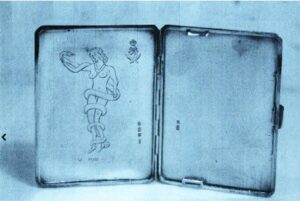
The cigarette case.
Summary
It is not just the Gurkha or other military museums which own artefacts and items associated with the Gurkha soldier, as evidenced by the continued interest shown by collectors of Gurkha militaria and the Indian Army of the Raj. There continued to be a paucity of medals awarded to Gurkhas being offered at auction, and those which came to the market invariably attracted a premium.
The auction market is global, and the days of possible good fortune by being present in person in the auction room, suitably armed with a paddle, are long gone. For example, last year Wimbledon Auctions sold a marvellous collection of original watercolours of various Indian Army uniforms by Brigadier General Alfred Lovett, which were all sold to a successful bidder who had ‘attended ‘ the online auction from New Delhi.
John Harrop