
Colonel D R Wood MBE

Colonel Denis Wood, who died on 22nd June 2026 at the age of 98, was a distinguished officer of the 2nd Goorkhas, an assiduous Regimental historian and archivist, co-founder of the Gurkha Museum, and a prolific contributor to the Military Historical Society. A man of considerable intellectual strength, in all his endeavours he was generous to a fault, providing information, advice and help to all those who required it.
Denis Wood was born on the 19th August 1927 in Newcastle-on-Tyne, the son of Colonel Roland Wood, who had been wounded in the battle of Passchendaele/Third Ypres in 1917 and commanded the 4th Battalion of the Royal Northumberland Fusiliers in the retreat to Dunkirk and subsequent evacuation. He was educated at Dame Allen’s School and later at Windermere School. He enlisted on 13th October 1944 as an Indian Army Cadet in the Queen’s Royal Regiment (West Surrey) – a date which enabled him subsequently to wear the War Medal 1939-45. He received basic and infantry training at Maidstone, during which he was injured in the arm, but recovered and after completing the course embarked for India on 12th October 1945. After six months at the Officer Training School in Bangalore he was gazetted to the Royal Northumberland Fusiliers but immediately seconded to the 2nd Goorkhas in Dehra Dun, he later said as a result of an inspiring conversation with a senior 2nd Goorkhas officer at Bangalore railway station.
From 1946 to 1948 he served with the 1st Battalion of the 2nd Goorkhas in Dehra Dun, Bombay and Poona as a company officer, company commander and quartermaster. From February 1948 to February 1949 he was Assistant Recruiting Officer for his battalion at the Depot at Kungraghat, near Gorakhpur, but also spent part of that time at the Depot at Jalupahar, Darjeeling. He was always very proud of having served in the Indian Army, and at the time of his death was one of its few surviving veterans.
During 1950 he was attached to 29 Transport Company Royal Army Service Corps (RASC) in Taiping, Malaya, as a troop commander, following which he attended the RASC Regular Officers’ Course in the UK. In December 1950 he was given a vacancy in the Permanent Cadre of the 2nd Goorkhas and returned to the Regiment on operations in Johore. He was Adjutant of the 1st Battalion from mid-1951 to mid-1953, for which he was mentioned in dispatches. Over the next two years he commanded A, D and HQ Companies in Malaya, and from 1958-59 was the Battalion’s Training Major. For his service in Malaya he was awarded the British campaign medal and also the Malaysian medal for the campaign, the Pingat Jasa Malyasia.
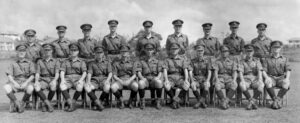
British Officers of the 1st Battalion at Majdee Barracks, Johore, in June 1951. Denis Wood is seated third from the left in the front rank.
After attending the Staff College Camberley Denis Wood was a Grade 2 Military Intelligence Staff Officer in the War Office in London, and immediately afterwards, in August 1963, attended a six month course at the US Armed Forces Staff College in Norfolk, Virginia. Returning to the 1st Battalion in Hong Kong in February 1964, he became Second-in-Command and deployed with it on three six-month operational tours in Brunei, the 5th Division of Sarawak and Sabah, for which he was awarded the Borneo campaign medal.
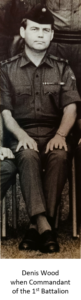 From 1st December 1965 he spent two years on the Directing Staff of the Staff College Camberley, a role for which his remarkable attention to detail well suited him. He commanded the 1st Battalion from 28th April 1968 in Brunei, and was awarded the Sultan’s Coronation Medal in Gold following the coronation on 1st August that year. The Battalion went to Slim Barracks In Singapore in December 1968 where it remained until he finished his tour in command on 27 April 1970, moving to a Grade 1 staff appointment in charge of Operations and Plans in General Headquarters Far East. After a spell on the Directing Staff of the Joint Services Staff College (renamed during his tour as the National Defence College) he was promoted to full Colonel and appointed Colonel General Staff Defence Intelligence 2 (South and South-East Asia and the Far East) on 15th September 1972, but the job was not to his liking and he retired from the Army on 31st October 1973.
It was the Army’s loss, and that of the Brigade of Gurkhas in particular, for as well as being a very capable and professional officer he was notably fluent in Gurkhali. Lieutenant Colonel JP Cross, a renowned native speaker of the language, gave his opinion that ‘his pronounciation was the best I had heard in either of your [2nd Goorkha] battalions. Certainly the men appreciated it’.
In civilian life Denis Wood worked as an Administrative Manager for a Life and Pensions company until he retired in August 1987. However, after leaving the Army most of his energies and enthusiasm were devoted to military history. He and his close friend Field Marshal Sir John Chapple – also a 2nd Goorkha – were the driving force behind moving the Gurkha Museum to Winchester in 1990. Originally set up in Queen Elizabeth Barracks in Church Crookham in 1973, the Museum’s move was a transformational project that not only gave it a new, more spacious home but very significantly raised the profile of Gurkhas in the UK – and beyond – by making their history easily accessible to the general public. It also established a prominent focal point for the Brigade in the UK where events could be held to celebrate and perpetuate its history. As well as organisational skills, he brought his significant financial astuteness and acumen to the project, which contributed greatly to its success and subsequent financial sustainability. He was Chairman of Museum Trustees from 1978 to 2003, and his success and leadership was recognised by his being appointed MBE. He subsequently became Vice-Patron of the Museum.
He also researched and wrote extensively. His fourth volume of the 2nd Goorkhas Regimental History, published in 2003, is widely regarded as a masterpiece of its kind, containing copious detail about the Regiment from 1949 to 1994, when it merged into the Royal Gurkha Rifles. He maintained a lifelong interest in his father’s Regiment, the Royal Northumberland Fusiliers, and wrote a definitive study of the ‘Fifth Fusiliers and its Badges’, which was published in 1988 with a second edition in 2014. He composed numerous articles for journals and newspapers, including 86 obituaries. As well as contributing many items to The Sirmooree (the journal of the 2nd Goorkhas) he also wrote numerous articles for the Indian Military Historical Society and the Military Historical Society, of which he was Vice-President.

Denis Wood was also an accomplished artist, as this 1969 sketch of a Regimental Bugler shows.
One of his most highly-regarded works was the Officers Register of the 2nd Goorkhas, listing service and other biographical details of all British Officers who served with the Regiment since it was raised in 1815, including those on secondment or attached. This compendium of 1447 individual records, many of them several pages long (including Wood’s own), was begun in 1968 with the help of Wood’s fellow officer John Holy-Hasted, but after the latter’s death and the completion of the Gurkha Museum project, it became Denis Wood’s principal focus of attention. It is a testament to his forensic attention to detail, his capacity for hard work over a long period of time, but above all to his love for his Regiment, and will provide a record of inestimable value to future researchers and historians.

Denis Wood (R) with his daughter Carolyn and Havildar Bhanbhagta Gurung VC in Nepal.
Denis was a serious and determined man whose intensity of purpose led to a very successful military career that would undoubtedly have progressed to higher appointments and rank had he chosen to continue with it. Although no athlete, his intellectual strengths and personal strength of character made him a very able officer. His ability to assess facts, figures and information, coupled with his exceptional attention to detail, made him a remarkable instructor and leader whose guidance helped and developed those with whom he served. In retirement he applied the same sterling qualities to the many projects in which he became involved, and his kindness in offering advice and mentoring has been noted by many of those with whom he worked. However, behind the seriousness he applied to his work was a man of great good humour whose experiences had provided him with a copious fund of anecdotes, many of them very amusing and with which he would happily regale friends and visitors over a glass or two of his favourite tipple, claret.
In recognition of Denis Wood’s achievements and contributions his Regiment inaugurated an annual lecture series in his name, the first of which will be given at the Gurkha Museum on 18th September 2026 by Lieutenant General Sir Peter Duffell, on the subject of the Borneo campaign.
In 1953 Denis married Bridget Christina (Chris) Flynn, a former nurse in Queen Alexandra’s Imperial Military Nursing Service, in Singapore. She was later a volunteer at the Gurkha Museum and died in 2011. They had one daughter, Carolyn, who cared for her father during the last years of his life and to whom we extend our heartfelt condolences on her loss.
Obituaries were published in:
- The Daily Telegraph on 3 July 2026.
- The Times on 10th August 2026.
- The Military Historical Society Bulletin, August 2026 edition.
NJHH
-oOo-
Reminiscences and eulogies of Denis Wood’s friends and colleagues:
Martin Brooks, Chairman of Trustees of the Gurkha Museum.
There is a lot to say about Denis, a remarkable man, from the Museum perspective, let alone from that of the 2nd Goorkhas. We have the opportunity to do this more expansively, when we hold, thanks to the generosity of the 2nd oorkhas, the inaugural Wood Lecture “Borneo The Secret War” to be given by General Sir Peter Duffell on Friday the 18th September at the Museum, when we hope Carolyn will be there.
Save to say for now that Denis along with Field Marshal Sir John Chapple were the driving forces behind the move from Church Crookham and the establishment of the Gurkha Museum in Winchester today. He was a very long-serving chairman of the Trust and as Carolyn and I discussed, his late wife Chris worked very hard at the Museum too for many years including working in the shop on Saturday. Denis donated our Lectern in her memory. Denis was also a force in the Military Historical Society, where he remained a Vice President, and where Field Marshal the Lord Richards among our more recent Vice Patrons is President.
I wanted to say at a more personal level he has been a wonderful mentor to me during my own chairmanship, for which I am very grateful indeed and will miss him greatly. All I could ever do in return was help him via a fellow Cornish friend translate some Cornish military mottoes that he was researching, an illustration of the sheer breadth of his interests.
Mr Doug Henderson, Assistant Curator at the Gurkha Museum
Though I interacted with him mostly in the earlier part of my career here, and only met him in person once, he certainly played a role in mentoring me into the intricacies of regimental history and ‘kaida’, in a way I know few people outside the military are ever given access to, and I hope my work here over the years has at least in some way been reflective of his drive, intellect and formidable memory.
Brigadier Christopher Bullock OBE MC, former Curator of the Gurkha Museum and former Chairman of Trustees:
Very sad but what a splendid innings! Whilst in 2GR our paths seldom crossed, from 1995 to 2008 I was working closely with him as Curator to him as Chairman of Trustees and then later as a 6GR Trustee until I took over from him as Chairman in 2003.
I had tremendous respect, admiration and affection for him. He, ably helped ,by the Field Marshal [Chapple] and Major John Lamond [former Museum Curator] was responsible for moving the museum from its Nissan huts in Church Crookham to Winchester, raising the finance to pay for the new displays and with Joy Ashworth from the design firm `Event’ creating the displays.
He guarded this new bright star in the Gurkha firmament with the tenacity of a creator which indeed he was. A kind and generous man he devoted not only all his energies but much of his own personal wealth to the museum. We owe him a great debt.
Never one to welcome new technology we were astounded that with the recent arrival of the mobile phone a message was received from reception that he had been spotted carrying one . Speculation abounded! Had he confiscated it from some early visitor unaware that they were not allowed in the galleries or was he actually using it ? When challenged he responded airily that he had bought it some time ago and didn’t know what all the fuss was! What Denis said concerning the museum was Gospel and always right and amazingly so it generally transpired. The rest of us never hesitated to consult him knowing he would set us on the right track and if uncontactable `What would Denis do? ‘ was the cry.
His other great calling was 2nd KEO Goorkhas and to them and their history and archives he devoted his huge talents to all our benefits ; his scholarship didn’t end there including a comprehensive history of the Northumberland Fusiliers , his family’s regiment.
Although the sporting arena was not his natural habitat never a season passed by without a foray on the Findhorn which a fellow trustee inelegantly described as `Denis tormenting the salmon!’! The result of these forays remained a mystery; in others an empty creel might be suspected but in Denis’s case innate modesty was probably at bottom.
When I first started as Curator Denis impressed upon me that anything emanating from the Gurkha Museum into the public arena must be absolutely accurate; with Denis The Brigade ,past and present, could rest easy.
Major Gerald Davies, former Curator of the Gurkha Museum:
Where can one start with what he has achieved during his lifetime and what he has given to help others through his knowledge and experience experiences.
I was privileged to have been under his leadership and guidance as Chairman of the Gurkha Museum and to have shared his incredible contribution to making the Museum become what it is today. His insight into financial markets and ensuring the best advice in setting the museum ahead of other regimental museums. His knowledge of regimental detail, new ideas of how future museum collections and new trends should be shaped was second to none. Also, being blessed with two Field Marshals as Patrons at the Museum he ran a formidable team that few could match.
Denis showed the best of British steadfastness in all seasons. He always gave his time to others and especially to the Gurkha staff at the museum. He will always be remembered.
Brigadier Bruce Jackman OBE MC, late 2nd Goorkhas:
As his Adjutant I got to admire his extraordinary attention to detail and his impeccable staff work. He was, after all, a DS at the Staff College. Also I recall the amount of time and effort he devoted to fundamentally restructuring the Regiment’s finances to generate income, something that had been lacking to our detriment in the past. And of course he produced Vol IV of our Regimental History, a masterful piece of work after an extraordinary amount of detailed research. We have much for which to be very grateful to him. A very sad loss indeed.
Brigadier Ian Rigden OBE, President of the Sirmoor Rifles Association:
This is terribly sad news. Denis was a good man who did a great deal for the Regiment, Brigade and the Army.
Like most of us, l got to know him really well over the years and remember his many kindnesses and for giving so generously of his time. One fond memory was spending several weekends with him and [Lieutenant Colonel] Gordon Shakespear in 1997 cataloguing all of the 2GR Regimental Property in Church Crookham.
It was fascinating being with officers who had sat at the Mess Table in Dehra Dun and in Malaya and to effectively receive a master’s degree level of education in our Regimental history in 6 x day long sessions led by Denis.
Colonel Nick Hinton MBE, late 2nd Goorkhas and co-author of ‘Remarkable Times, Remarkable Men’, a history of the 2nd Goorkhas:
Denis was one of the Regiment’s many remarkable men. He was totally dedicated to recording and perpetuating the history of his Regiment and the Brigade. I did not know him well, but consulted him on several occasions over the years and was always provided with prompt, detailed answers to whatever queries I had raised. John Harrop and I used to joke about his ‘red-ink corrections’ of anything and everything we wrote, but they were always presented in a positive, constructive and helpful way with the sole intention of making sure the historical record was correct and consistent. I stand in awe of his Officers Register, nearly one and a half thousand detailed biographies whose compilation left at least two of his helpers trailing by the wayside while he forged on, continuing to update and amend the records as new information became available until very nearly the end of his long life.
He was a thoughtful and kindly man, as was evident from my first encounter with him. In 1986 I won some essay prize at Staff College, and out of the blue a congratulatory, handwritten letter arrived from him. He had somehow got to hear of my modest success and as a former instructor at Camberley had appreciated its significance and taken the trouble to write. All my subsequent dealings with him showed the same thoughtfulness and enthusiasm for celebrating the achievements of the Regiment and of its officers and men.
I shall greatly miss the wise counsel and help from the ‘Sage of Islington’.
Lieutenant General Sir Peter Duffell KCB CBE MC, late 2nd Goorkhas:
Denis Wood was a great chronicler and upholder of all that is best in the Sirmoor Rifles and his passing at a great age – all the while intellectually active to the very end – represents the end of an historic era for our Regiment. He was a great contributor and I much regret his passing.
Major John Harrop, late 2nd Goorkhas and co-author of ‘Remarkable Times, Remarkable Men’, a history of the 2nd Goorkhas:
Such sad news. Such a remarkable Sirmoori.
Major David Thomas MBE, late 2nd Goorkhas:
What a wrench it is to be going down one’s ordinary list of emails and then to come across such miserable news as the death of Denis Wood. We are all much saddened.
Brigadier John Brewer CBE, late 2nd Goorkhas.
A sad loss but I know we all learnt a lot from his generous advice and guidance in many subjects.
Brigadier Clive Elderton CBE, Chairman of the Military Historical Society.
The Society owes a tremendous debt of gratitude to Colonel Denis Wood. A most active member of the Military Historical Society for over 50 years, he was the first and for almost twenty years Chairman of the Committee and, recently, a most diligent and conscientious Independent Examiner of our accounts and a very active Vice President. Denis was a prolific contributor to ‘The Bulletin’ and members enjoyed Denis’s recent series of short biographies entitled “20th Century Warriors Par Excellence” in which he treated us to unique insights into several courageous and colourful Gurkha officers with whom he served. Despite my urging, I never did succeed in getting Denis, always typically modest, to write up his own distinguished and fascinating Army career.
In 2000 Field Marshal Sir John Chapple, as President, and Denis successfully ambushed me onto the Committee of The Military Historical Society and shortly thereafter, in “a subsequent operation” I found myself taking over from Denis as Chairman. Up against two formidable Gurkha officers, I was a lamb to the slaughter some might say, but I am hugely grateful to them for springing their ambush and exposing me to a marvellous “brigade” of kindred spirits over the years. I could not be more grateful to Denis for his mentoring, his support, his encouragement and his friendship throughout my time in the Chair. Of course Denis played a similarly active role in the Indian Military Historical Society and when that Society became unsustainable in 2021 he was very supportive of the merger with the Military Historical Society.
The passing of Colonel Denis Wood really does mark the end of an era; a proud Goorkha, a wonderfully talented man; a true gentleman to who so many owe so much. In mourning his loss the Military Historical Society can be grateful for all he achieved in his long life and for the massive contribution he made to the recording and preservation of military history and heritage.
Captain Bharat Singh Thapa Chhetri, Chairman of the Sirmoor Club Nepal.
I heard about Col Wood’s passing and I’m going to write to his daughter, Carolyn, on behalf of all 2GR members.
I knew Col Wood very well. In the clerical circle we often used to talk about his and Brig Jackman’s handwriting [both of which were very neat and clear]. During the Borneo confrontation 1964-66, Colonel Wood was our Battalion 2IC at the Tac HQ in Limbang. He later commanded the Battalion. We will always remember Wood Saheb as a very loyal and committed Regimental officer for what he did to set up, record and improve our regimental history.
Way back in 1974/75 when I was in the UK and on a weekend stay at FM [Chapple] Saheb’s house in Islington, North London, I was invited to a Gurkha curry lunch at their house in Sussex. Mrs Wood Memsaheb treated us to a very nice dhal bhat Gurkha curry. We had a very enjoyable day.
Lieutenant Colonel Tony Lea MC
Denis was CO and I was OC Support Company with the task of planning and implementing a battalion-size live firing exercise on the Asharan ranges in Malaya codenamed Canons Roar. Denis and I flew in a Scout helicopter to survey the area. When almost finished and about to land there was an almighty loud ‘bang’ above my head (I was sitting in the rear seat and Denis in the front left hand seat) followed by a very rapid descent! We landed rather quickly but fortunately the right way up. I remember becoming conscious after a few moments and seeing the yellow and black tape on the door handles and pulled it like hell. The whole side of the helicopter fell away and after scrambling out I was able to open Denis’s door and pulled him out and then did the same for the pilot.
On the arrival of a relief helicopter the questions from the squadron commander started but the only one which I was asked was why I had pulled the emergency taped handles. – I cannot remember my reply but I expect that it was suitably short.
A cocktail party had been planned for that evening in Singapore at which Denis was the host. He did not want to be late so he and I flew directly to the Slim Barracks square. I remember a few eyebrows eyes were raised when he and I appeared in our jungle kit but after champagne was ordered and the reason for it explained there were cheers alrl round and the party proceeded – including the pilot!
Lieutenant Colonel Rodney Buckton, late Royal Northumberland Fusiliers
(Colonel Buckton was a lifelong friend of Denis Wood through their shared association with the Royal Northumberland Fusiliers)
Denis told me of wartime days at boarding school in Cumbria. When a night air raid warning was sounded (industrial Barrow-in-Furness was nearby), boys and staff hurried to the cellars- which were used for woodwork classes – and ended up unsuccessfully trying to sleep on carpenters’ benches !
In India in 1947, the C-in-C, Gen Sir Claude Auchinleck, used to travel round that huge country by train, inspecting the various garrisons as he went. Denis and his Gurkha platoon were once detailed to be the “train guard” for the great man, protecting his coach both by day and by night. This meant that Denis saw a lot of the C-in-C, and he reflected at the time that he must have been the only 2/Lt in the Indian Army getting a cheery “Good Morning ” every day from a General !
During the Malayan Emergency, some bright staff officer in MoD thought it would help our troops to hunt down the Communist terrorists if they had tracker dogs on the trail. Several dogs were duly flown to Singapore, and sent straight to forward units. Denis’s Company was given two. But unacclimatised and after just one day on patrol in the jungle, both dogs collapsed suddenly from heatstroke, and the Gurkhas had to carry them on their shoulders back to camp !!
Lieutenant Colonel J P Cross OBE
A good and great man has left us. He was ‘two up’ when I was DA Laos and, later when he read my autobiography, wrote to say he simply couldn’t believe how I managed to cope with the situation where the UK ambassador was a fellow-traveller and anti-US. As for his regimental and historical devotion I have all four volumes of the 2GR Regimental history and his is in a category of excellence of its own.